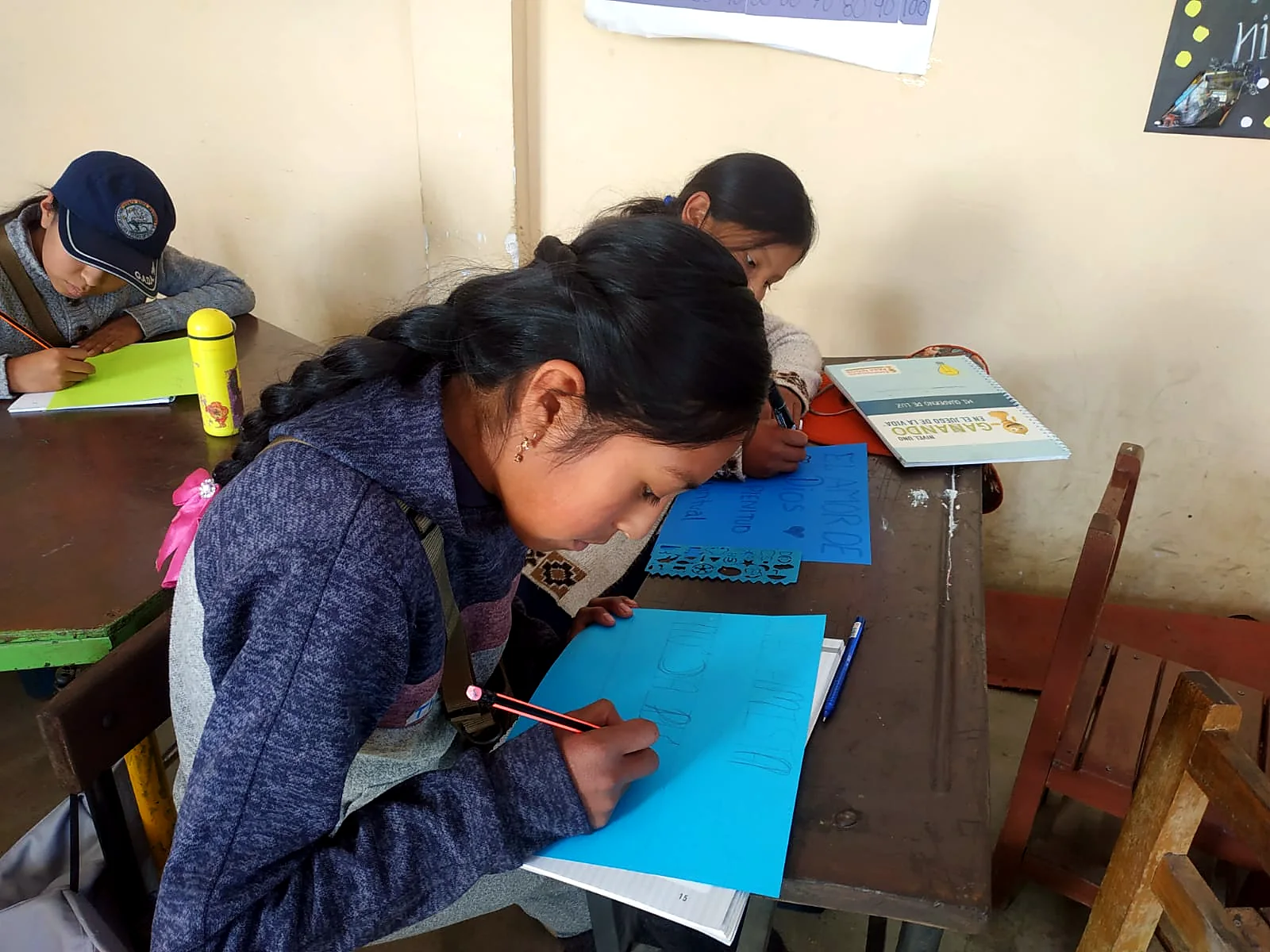

Learning is not a circle. It is a spiral.
I write from a conviction that guides Zera: Bolivia is Indian, and our identity is not a checklist but a living textile of body, land, language, practices, memory, community, and choice. Racism exacts a price for naming it, while purity makes it smaller. Our task is to build an open house where children inherit critical thinking, emotional intelligence, and the freedom to know themselves as creators.
I. The checklist and the textile
The idea of being less Indian has always reached me in shades. Having skin a tone lighter than my cousins': less Indian. Speaking English: not quite as Aymara. Not having returned to the village festival on July 16: less. My last date, a Moroccan man: less Aymara. I do not speak the language: less still. Beneath every shade lies the accusation that living in New York erases something. Someone is always willing to stand at a door with a list in hand.
I grew up inside Aymara life, contradictions included. Ch'allar, preparing ceremonial mesas, going to prestes, pasanaku, gold jewelry, coca chewed with your back to the afternoon sun until your teeth turn green. These practices are not a costume I put on: they are my childhood. From that place, I refuse to let identity become an inventory, because I know what practices protect and what they do not. They are interrupted. Migration interrupts them: nobody makes a mesa smoke in a rented apartment where the lease forbids it. Poverty interrupts them: gold jewelry remembers the road to the pawnshop, and not always the road back. History interrupts them: in entire families, the language stopped cold within one generation because school beat it into silence. If belonging depends on a list, anyone can threaten it, deny it to you. The diaspora knows that list; the migrant knows it by heart. I do not accept it.
The other part of the story comes in numbers, data. In the 2001 census, 62 percent of Bolivians over the age of fifteen identified as Indigenous.¹ In 2012, 41 percent.² In 2024, 38.7 percent.³ Did we disappear? No. People did not stop being; they stopped saying, stopped naming themselves. Nobody runs from what they are: they run from its price. The only reason someone does not want to be Indian in Bolivia is that they know exactly what it costs, because we have all seen that price collected: in the bank line, in the job interview, in the schoolyard, in the tone used with a mother in a pollera and the different tone unveiled when her son arrives in a tie. That decline does not measure identity; it measures fear. Fear is not healed with stricter lists or new requirements. It is healed as women have always healed what hurts: by opening the house, setting the table, reaching for the remedies.
Before opening the house, I want to explain the words I use to name it, because I do not use them casually. I say Aymara because it is the name of a nation: a people with language, memory, and territory, older than every republic that tried to administer, dominate, and tame it. I say Indigenous when I speak the language of states and law: it is the category used by ILO Convention 169, the United Nations, and our own Constitution, and it is useful for negotiation, so I keep it.⁴ And I say Indian knowing that we did not choose the word: it was hurled at us. I pick it up on purpose. Half a century ago, Fausto Reinaga offered us his understanding, like an offering, when he wrote that as Indians we were subjugated and as Indians we would have to liberate ourselves: a wound opened with a name does not close with a euphemism.⁵ When I say Indian, I am not decorating a text. I am lifting from the ground the word used to strike us and returning it transformed into construction, house, home.
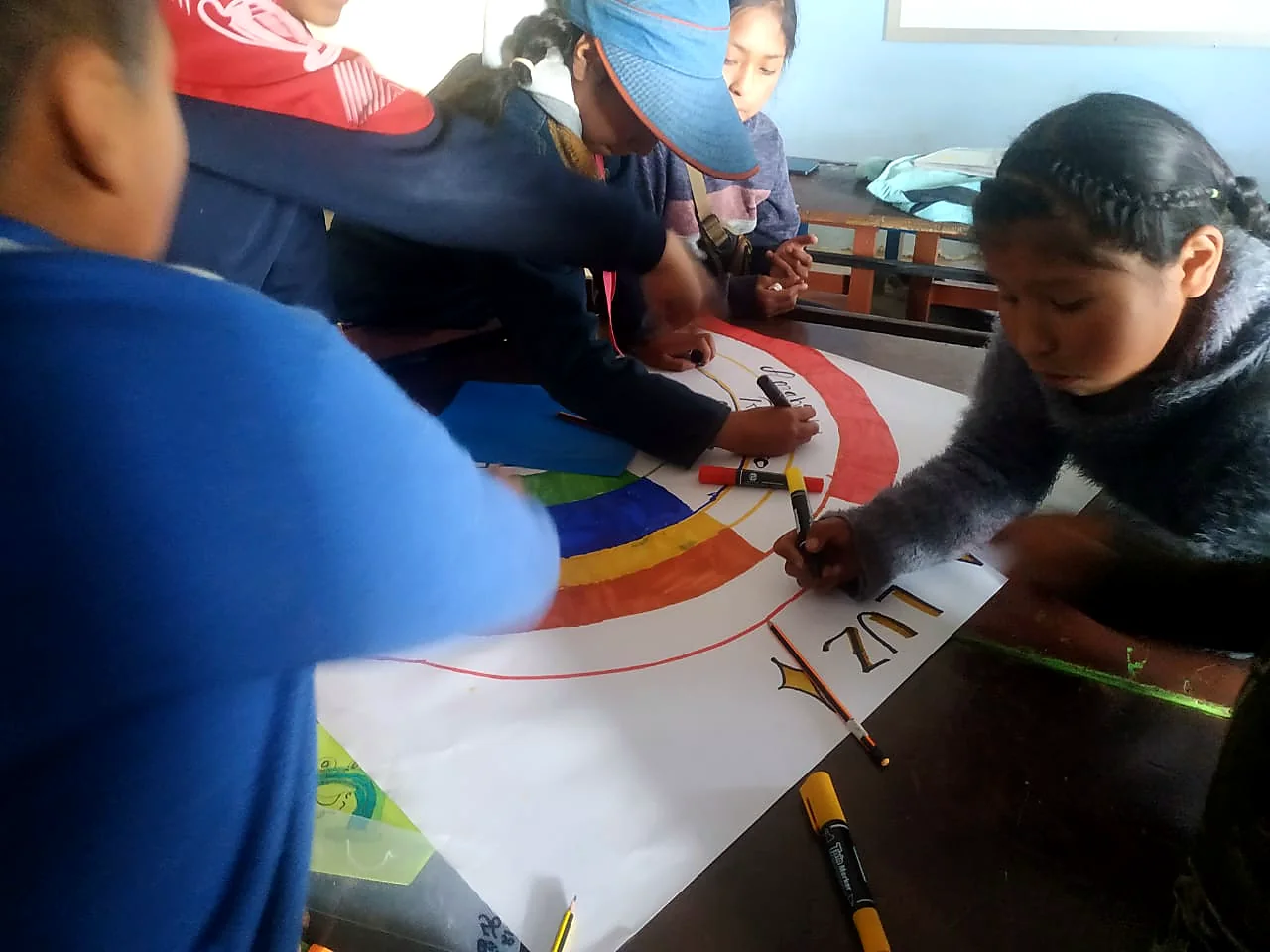 We build from our own ground.
I propose, then, that we see identity as a weaver sees her work. To be Aymara, to be Indian, is a textile, wool of many colors, like an aguayo. The body is one thread: it carries blood, face, and knowledge that we may transform into wisdom if we choose, knowledge no border can confiscate. Land is a thread, and it travels with the migrant: El Alto is Aymara land made through migration, and today it is land that generates migrations of its own. Language is a thread: it can be lost in one generation and return in the next, like the granddaughter who now studies the Aymara that her father was forbidden to speak through beatings or through the accumulated looks of contempt and distance. Practices are threads: the ch'alla, apthapi, and q'uwa bear witness to belonging, but they do not grant permission to belong. Memory is a thread: the one that makes us say "they did this to us" and not "they did this to them." Community is a thread: ayni, showing up when it is your turn, for the roofing, the mourning, the celebration. And choice is a thread: the grandson who returns, the woman who learns, the man who serves and stays. No thread is a requirement. Any one is enough. An aguayo is strong because its threads cross; a single thread, however pure, cannot warm, shelter, or carry. Our fluidity does not dilute us: it enriches us.
To say that we all belong is not to say that we all pay the same price. Power assigns a different price to each thread depending on the setting: the face costs more at a police checkpoint, the pollera at the university, the language is worth more at a village preste than in a courtroom. To be expansive is not to be naive: we know who pays what, and we say it. What we do not accept is allowing the price of racism to become the measure of anyone's worth, or an internal ranking of who is more Indian.
I know this unsettles the guardians of purity, and I want to speak to them without caricature, because their vigilance has reasons: they have watched folklore empty the sacred and the market dress itself with us and as us. But the test they administer has a history, and that history should be told in full. It is hard to imagine a machine for classifying people more meticulous and relentless than the colony. Registers, castes, certificates, purity of blood: to classify was to govern. A category for every body, a price for every category. When today we require a sister to have been born on the altiplano, to speak the language, to pass a test of authenticity, we are not protecting anything: we are operating that same machine, only now with our own hands. The exam questions are the same as ever. Where were you born? What do you speak? What proof do you have? The actor is reversed and the direction changes, but classifying and expelling remain colonial operations. The result is also the same: the people become smaller. Each new requirement is a thread pulled from the textile. Decade after decade, the census counts the threads that have been pulled.
And in the midst of it all, on a rainy Tuesday in this divided country, the whitest and most conservative woman in Bolivia cannot resist a craving for api. She says wawa without thinking, says ch'alla, says aguayo; more than once she has called the young woman who helps at home imilla, and in that single word live both the Aymara she speaks without knowing it and the contempt she learned without realizing it. She has her new car blessed with a ch'alla, even if the wine and cheese on her table are imported. At Alasitas, she buys her miniature dream house and has it blessed twice, by the priest and by the yatiri, just in case. Her Spanish is woven with Aymara and Quechua; her body almost always carries more history than her surname is prepared to admit. I am not accusing her of anything. I am inviting her to look at herself.
And if anyone thinks this is only vocabulary, a handful of borrowed words, look at its depth. Bolivia's Indian identity does not end with language. It lives in money: the pasanaku played in homes in the Zona Sur is the same institution of rotating trust that sustains the merchants of Uyustus and the families of Río Seco and Plan 3000, and no bank invented it. It lives in the way people buy: in Bolivia, nobody has a supplier, they have a casera, and one asks the casera for yapa, because here even commerce is a relationship that must be cultivated. It lives in celebration: the fraternities where the children of prominent families now dance morenada and caporales are also organized through sponsors, offices, and turns, the logic of the preste in another costume. It lives in fear and hope: on the Tuesday of ch'alla, incense is burned over the market stall, the bank office, and the ministry desk alike. And it lives in death. I will not paint a picture that does not exist: at the end of every October there are more pumpkins trying to become American and more costumes, and that is globalization, which passes through here as it does through the entire world. But look at what happens inside a single home, in El Alto or the Zona Sur: on the night of the thirty-first, children go out in costume asking for candy, or a Halloween party is held; and the next day, in that same home or the one next door, t'antawawas and bread ladders wait for the souls. Nobody feels any contradiction. The costume belongs to the season. The bread, meanwhile, is already the child of an encounter: wheat arrived with the Spanish; the practice of feeding the dead in November was here before them, and Guaman Poma left it in a drawing.⁶ That gesture has survived the centuries and each century's enthusiasms, taking possession of what arrives from outside so as not to lose what is within, and it will continue to do so. Death is where a people do not lie. A country that still waits for its dead in this way does not wear Indian identity as an ornament. It carries it in the way it trusts, celebrates, fears, and says goodbye.
Bolivia is Indian. Not as a slogan against anyone, but as a simple description. Indian identity is not a minority in Bolivia: it is Bolivia's water, vital and indispensable. The day water understands that it is water, we will stop fighting over who is wetter.
II. The wages of contempt
Sometimes naming awakens shadows and beasts, fear and desperation, violence. I have seen it before. May 2008, Sucre's main square; dozens of peasants forced to kneel with bare chests under the force of contempt, while their ponchos and wiphalas burned right there and the square shouted.⁷ The smell of burning does not simply leave a square. Not after this kind of burning. Eleven years later, the same fire returned: wiphalas were cut from police uniforms, wiphalas burned in the streets.⁸ The Constitution had already placed the multicolored flag among the symbols of the state, a thread of the country's own textile burned by the hands that had raised it. Ash cools in a moment. The original spark has lived dormant for five hundred years.
Why? How does someone come to burn their own flag? In Bolivia there are not only those who learned not to see their thread, their bond: they live from not seeing it. Rejection of the Indian is inherited like a corner shop, and like every shop, it is tended. Little by little, every day: in the accent that is monitored, the surname that is polished, the marriage that improves the race, the "do not be Indian" used to correct a daughter. And like every shop, it yields a profit. Rejection is the trade; contempt, the industry. The wages appear on no payroll, but everyone knows them: the line that moves forward, the word that is received and respected, the accommodating young woman, the view from above and over the shoulder, with advantage. To touch their rejection is to touch their wages. That is why they answer with fire, with inquisitorial urgency.
But look closely at the business, as one stops before a grotesque work of art or a suspicious contract before signing it: the person who defines herself by not being Indian needs the Indian every morning. She needs him to know who she is, to know where she stands, to measure what she is worth. She has handed him the rudder of her being and existence. There is no more complete servitude in this world.
Then there is what the contract does not say: denial is exhausting. It is work for every day and every hour. One rises early to monitor the accent, stays up late polishing the surname, and there are no Sundays or holidays, because the Indian one denies returns in every mirror, every family photograph, every grandmother. Nobody pays a year-end bonus for that work. Nobody retires from it alone. That is why my naming is an invitation. It does not come to accuse, forgive, or convert: it comes to retire you. Close the shop and enter the house: the table, the apthapi, has been set and waiting for so long. There is only one price: give up the wages of looking down, give up the work of contempt. Some will prefer to burn, reject, and deny themselves, and they are free to do so. The house is not built at the pace of whoever resists or blinds themselves the most.
To the diaspora I say what nobody told me soon enough: if your mother, father, or grandmother is Aymara, you are Aymara. If something binds you to the land, history, language, or table, a place has been set for you. I think of chuño, the potato that survives the frost by allowing itself to be transformed. It no longer looks like a potato, and it is a potato. It lasts for years, crosses distances, and nourishes. What interruption transformed did not cease to be what it is. We are stronger when there are more of us.
From this perspective, I could not describe my work as decolonial, and I want to explain why, because this is not a whim about vocabulary. I study the colonial structure deeply because what you do not understand governs you. But defining yourself against the oppressor means continuing to orbit around the oppressor: their intentions mirrored, identity as response, the future as reaction. I refuse to let our being and our worth be organized around what someone else did. We are nobody's antithesis. There is a liberation so free that it does not need to claim the name of liberation: it simply builds. And we practiced it once before. In 1931, at Warisata, Avelino Siñani and Elizardo Pérez did not found a pedagogy of protest: they founded a school of the ayllu, on Aymara land, with Aymara logic, governed by its own parliament of amautas. It was the state that had to travel to it.⁹ We build where we stand and make the center travel to us.
And because building means looking at inheritance with open eyes, I also say this: almost everything we inherited passed first through men's hands, including within our communities. We inherited the ideal of chachawarmi, the authority of woman and man walking side by side, and we inherited the distance between that ideal and the concrete lives of our mothers: who speaks in the assembly and who cooks for the assembly. I will not romanticize what is ours to avoid unsettling our own. A people who know themselves as creators do not carry forward unchanged what harms half their people. Making that parity real is part of the work, not a footnote.
This is Zera Bolivia. Zera means seed. We serve Bolivia's children, beginning with those who pay the highest price today, teaching critical thinking and emotional intelligence, naming racism and sexism without organizing ourselves around them. We work so that the wawas inherit the open house and not the checklist: an identity secure enough to afford generosity.
Not survival. Not only self-determination. Self-actualization: the practice of a people who know themselves as creators. In one generation, the share of Bolivia that identifies as Indigenous fell from six in ten to fewer than four, because naming it carries a cost. Our task is not to force anyone to return. It is to build an Indian identity so broad, dignified, and fertile that returning becomes natural, as water returns to water. Bolivia is Indian. When we can say it without fear, another era begins. Not as revenge: as germination.
Sharoll Fernandez Siñani is a visual artist, poet, and Aymara thinker. She is the founder of Zera Bolivia.
Sources and notes
- Bolivia's National Institute of Statistics (INE), 2001 National Population and Housing Census: 62 percent of the population aged 15 and older (3,142,637 of 5,064,992 people) self-identified with an Indigenous or original people.
- INE, 2012 National Population and Housing Census: 41 percent of the population aged 15 and older (2,806,592 of 6,838,606 people) declared that they belonged to an Indigenous original peasant nation or people.
- INE, 2024 Population and Housing Census, results published in August 2025: 38.7 percent of the population (4,302,484 people) self-identified with an Indigenous original peasant or Afro-Bolivian nation or people. Unlike the 2001 and 2012 figures, which concern the population aged 15 and older, the 2024 figure was published for the entire enumerated population. All three are official INE figures and are the figures compared within Bolivia's own public debate. Press coverage: El Deber, August 28, 2025; EFE/Infobae, August 29, 2025.
- International Labour Organization Convention 169 concerning Indigenous and Tribal Peoples (1989), ratified by Bolivia through Law 1257 of July 11, 1991; Political Constitution of the State (2009), Articles 2, 3, and 30, which establish the category "Indigenous original peasant nations and peoples."
- Fausto Reinaga, La Revolución India (La Paz, 1970). The formulation in the essay paraphrases its central thesis: the liberation of the Indian must be carried out as Indian, not under another name.
- Felipe Guaman Poma de Ayala, El primer nueva corónica y buen gobierno (c. 1615), chapter on the months of the year: November, "aya marcay quilla," the month of carrying the dead, with its corresponding drawing.
- On May 24, 2008, in Sucre's Plaza 25 de Mayo, dozens of peasants were forced to kneel bare-chested while their ponchos and wiphalas were burned. The event was documented by Bolivia's Ombudsman's Office and by national and international media. In memory of that date, Law 139 (2011) declared May 24 the National Day against Racism and All Forms of Discrimination.
- During the political crisis of November 2019, burnings of wiphalas and the cutting of the emblem from police uniforms were widely documented by the press. The wiphala is a symbol of the state under Article 6 of the Political Constitution of the State (2009).
- The Warisata school-ayllu was founded on August 2, 1931, by Avelino Siñani and Elizardo Pérez and was governed through its Parliament of Amautas. The state, which recognized it and later intervened and dismantled it in 1940 and 1941, eventually adopted its date and names: August 2 was declared Day of the Indian under the government of Germán Busch, and the current education law, Law 070 of 2010, is named Avelino Siñani and Elizardo Pérez. See Elizardo Pérez, Warisata. La escuela-ayllu (La Paz, 1962).
Terminology note: in the essay, Aymara names the nation; Indigenous is used as a legal and international category; Indian is used as a deliberate reclamation of the colonial term, following the path opened by Reinaga.